Why Does My Tooth Hurt? Common Causes Near S Loop, Houston TX
Reviewed by Urgent Dental Care of Houston Team. Last updated on 11/23/2026.
A tooth can hurt because of decay, gum disease, a crack, an abscess, or an impacted tooth. The ADA's MouthHealthy guide to top dental symptoms says a toothache should be evaluated by a dentist right away. Sometimes the pain is referred from a sinus infection or an earache, as MedlinePlus explains. You cannot know the exact cause until a dentist examines it.
If the pain is disrupting meals or sleep near the Texas Medical Center, our team at 3264 S Loop W can check the tooth and explain what it needs.
Short Answer
Tooth pain is a symptom, not a diagnosis. Decay, a crack, gum problems, an abscess, or an impacted tooth can all cause it, and so can a sinus issue or pain referred from nearby. Home care can make you more comfortable, but it does not treat the cause. An exam and, when needed, X-rays are the reliable way to find out why your tooth hurts.
Key Takeaways
- A toothache often points to decay, but it can also come from gum disease, a crack, an abscess, or an impacted tooth.
- Pain that lasts more than 2 days, does not ease with painkillers, or comes with swelling, fever, or a bad taste needs a dentist visit.
- Rinse with half a teaspoon of salt in a glass of warm water, then spit it out. Do not put aspirin on the tooth or gums.
- Swelling around the eye or neck, or swelling that makes it hard to breathe, swallow, or speak, belongs in an emergency room.
- You cannot confirm the cause, or rule one out, without an exam.
Table of Contents
- Why does my tooth hurt?
- What do different kinds of tooth pain mean?
- How is a hurting tooth treated?
- What can you do at home until you are seen?
- When should you see a dentist or go to the ER?
- What does this look like near S Loop?
- Frequently Asked Questions
- References
Why does my tooth hurt?
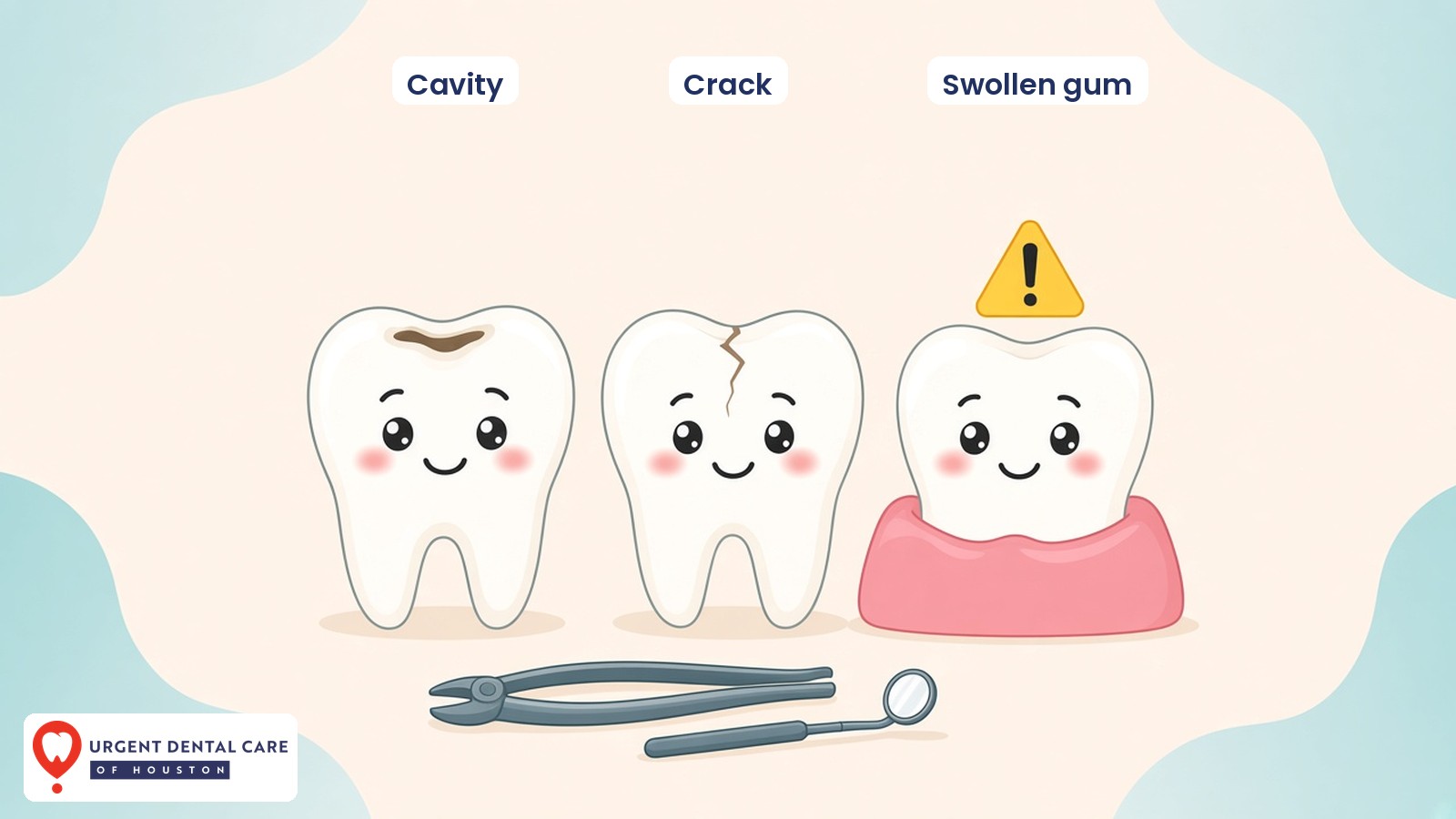
A tooth usually hurts because something is irritating the pulp, the soft tissue inside the tooth that holds the nerves and blood vessels, or the gums and bone around it. The NHS toothache page lists common causes such as tooth decay, a dental abscess, a cracked or damaged tooth, a loose or broken filling, gum disease, grinding, or an erupting wisdom tooth that does not have enough room. MedlinePlus also lists sinus infection, earache, injury to the jaw or mouth, and, less often, referred pain from a heart attack, which can include jaw pain, neck pain, or toothache.
According to Dr. Luu, the pattern of the pain is a useful clue, but it is still only a clue. Two teeth can hurt in a similar way and still need different care.
What do different kinds of tooth pain mean?
The type of pain can narrow the list, but it cannot replace an exam. The American Association of Endodontists notes that momentary sensitivity to hot or cold often points to minor decay, a loose filling, or a small area of exposed root, unless it lasts. Sharp pain when you bite may come from decay, a loose filling, a crack, or pulp damage. Pain that lingers, typically more than 30 seconds after hot or cold, can mean the pulp has been damaged enough that it may not recover on its own.
Constant, severe pain and pressure, with gum swelling and tenderness, may mean an abscess. A dull ache and pressure in the upper teeth and jaw may come from grinding or from a sinus headache. For those patterns, see our guide to throbbing, sharp, or dull tooth pain, plus whether a sinus infection can cause tooth pain and whether a toothache can cause ear pain.
How is a hurting tooth treated?
Treatment depends on the cause, and it usually starts with the least involved option that can protect the tooth. You hear the plan, and the cost, before treatment begins.
For mild, brief sensitivity, the AAE suggests trying toothpaste made for sensitive teeth and brushing with a soft brush in an up-and-down motion. If decay is the problem, a filling can remove the damaged part and seal the tooth. A loose or broken filling may need to be replaced. If a crack or a large area of damage weakens the tooth, a crown or another repair may be needed.
When the pulp is badly damaged, root canal treatment can clean out the inside of the tooth so it can be saved, as the AAE describes. If the tooth cannot be saved, extraction may be the safest option. For an abscess, the ADA notes that treatment may include antibiotics, drainage, cleaning around the gums, or a root canal, depending on the source. Antibiotics alone do not finish the job if the cause inside the tooth is still there. Our S Loop toothache treatment page and oral pain relief pillar page explain how we evaluate urgent mouth pain.
What can you do at home until you are seen?
Home care can ease symptoms, but it does not treat the cause. The NHS says you can take ibuprofen or paracetamol (acetaminophen) if it is safe for you and you follow the label, and that children under 16 should not take aspirin. Eat soft foods and avoid very hot, very cold, or sweet foods.
To rinse with salt water, dissolve half a teaspoon of salt in a glass of warm water, rinse, then spit it out. Do not swallow it. Children should not try this, in case they swallow it. The ADA's dental emergencies page also says to rinse with warm water and to gently floss out trapped food. Do not put aspirin on the aching tooth or gums. If painkillers stop helping, that is a reason to be seen sooner, not a reason to take more than the label allows.
When should you see a dentist or go to the ER?
See a dentist if toothache lasts more than 2 days, does not go away when you take painkillers, or comes with a high temperature, pain when you bite, red gums, a bad taste, or a swollen cheek or jaw, per the NHS. MedlinePlus also advises care for a severe toothache, pain that lasts longer than a day or two, or toothache with fever, earache, or pain when opening your mouth wide. The ADA says a toothache should be evaluated right away.
Go to the emergency room if the area around your eye or neck is swollen, or if swelling makes it difficult to breathe, swallow, or speak, as the NHS directs. MedlinePlus calls a swollen area of the upper or lower jaw a very serious abscess symptom. If tooth or jaw pain comes with chest pain, shortness of breath, or other warning signs of a heart problem, seek emergency medical care. MedlinePlus lists a heart attack as a possible source of referred toothache.
What does this look like near S Loop?
Imagine a back tooth starts throbbing on a Friday after a long day near South Main or Braeswood Place. The tooth may look normal in the mirror. Dr. Luu notes that getting an exam sooner often means more ways to protect the tooth.
Our S Loop office is at 3264 S Loop W, Houston, TX 77025. It is open Friday, Saturday, and Sunday from 8AM to 8PM. Same-day and walk-in visits can start with the $89 emergency exam.
Frequently Asked Questions
Why does my tooth hurt when I bite down?
Sharp pain when you bite can come from decay, a loose filling, a crack, or damage to the pulp, according to the AAE. It can also come from a problem in the jaw joint. An exam is the reliable way to tell those apart.
How long can I wait on a toothache?
The NHS says to see a dentist if toothache lasts more than 2 days, or sooner if you have swelling, fever, pain when you bite, red gums, or a bad taste. MedlinePlus uses a similar window of longer than a day or two.
Is it safe to use painkillers until I get in?
Over-the-counter pain relievers can help if they are safe for you and you follow the label. The NHS says children under 16 should not take aspirin, and you should not put aspirin on the tooth or gums. Painkillers do not treat the cause.
A note from Urgent Dental Care of Houston
A hurting tooth is asking for a clear answer, not a guess. We can examine the tooth, explain what we see, and go over the next step in plain language. Home care can make the wait more comfortable, but it is not a substitute for finding the cause.
Call Urgent Dental Care of Houston at (346) 551-4600, or visit 3264 S Loop W, Houston, TX 77025. We are open Friday, Saturday, and Sunday from 8AM to 8PM.
References
Last updated on 11/23/2026.
Our articles are based on evidence-backed information from trusted health organizations to keep them accurate and up to date, and they are written with input from our clinical team.
- American Dental Association, MouthHealthy. Top 10 Dental Symptoms (https://www.mouthhealthy.org/top-dental-symptoms). Accessed 11/23/2026.
- National Library of Medicine, MedlinePlus. Toothaches (https://medlineplus.gov/ency/article/003067.htm). Accessed 11/23/2026.
- NHS. Toothache (https://www.nhs.uk/symptoms/toothache/). Accessed 11/23/2026.
- American Association of Endodontists. Tooth Pain (https://www.aae.org/patients/dental-symptoms/tooth-pain/). Accessed 11/23/2026.
- American Dental Association, MouthHealthy. Dental Emergencies (https://www.mouthhealthy.org/all-topics-a-z/dental-emergencies/). Accessed 11/23/2026.